Journal
29 October 2026
Reading Time: 7'
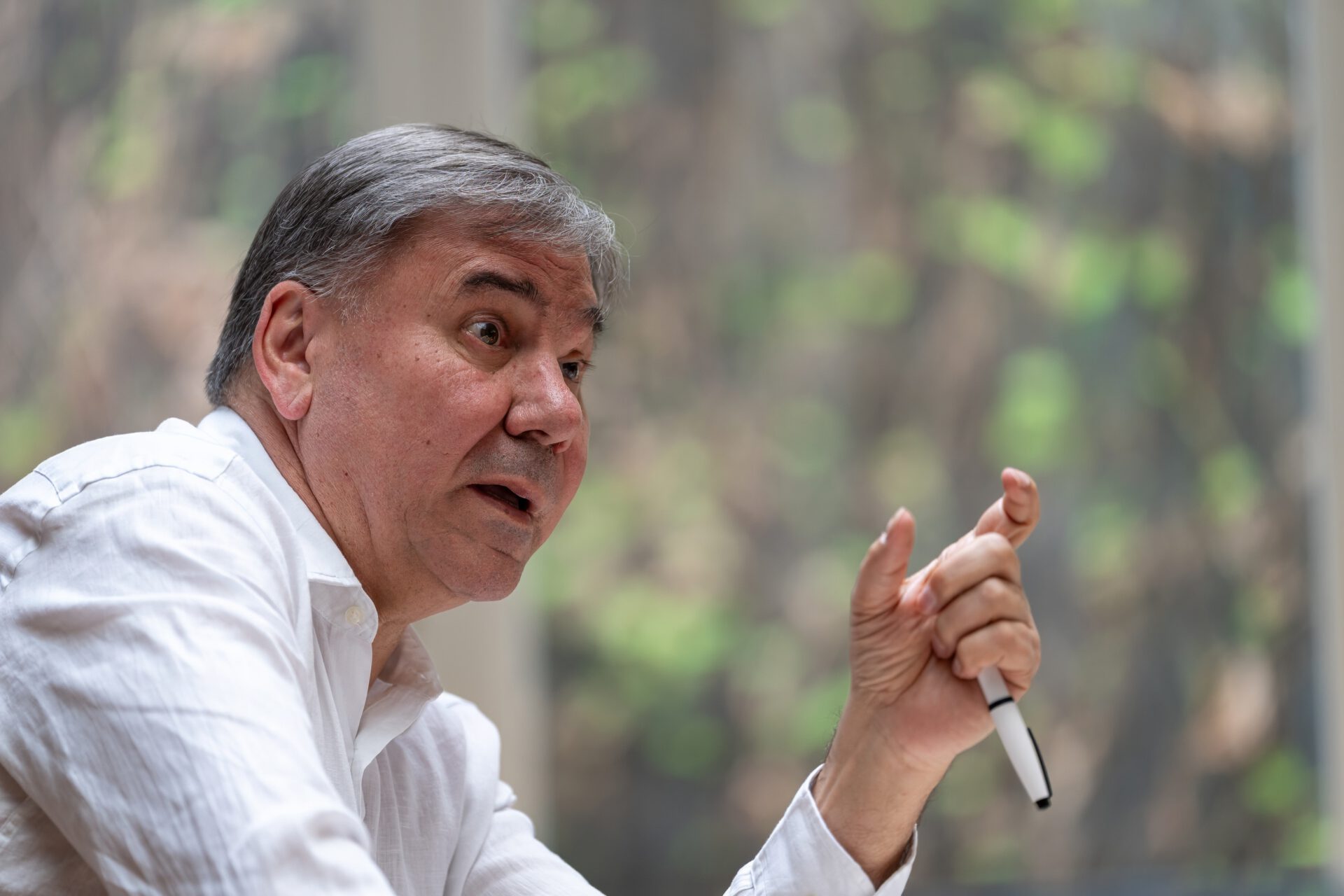
Three Questions to Ivan Krastev
Ivan Krastev is chairman of the Centre for Liberal Strategies, Sofia, and Albert Hirschman Permanent Fellow at the Institute for Human Sciences in Vienna (IWM). In 2019 he was awarded a Mercator Senior Fellowship and in 2020 both the Jean Améry Prize for European Essay Writing and the Lionel Gelber Prize for his book The Light that Failed. A Reckoning. He is also a founding board member of the European Council on Foreign Relations.
On the occasion of the launch of the Facing the Future Fellowship, a strategic partnership between ERSTE Foundation and IWM, we spoke to Ivan Krastev about the current crisis of the liberal democratic model, the return of a visual and oral culture and the need for new questions and ideas at times of radical change.
ERSTE Foundation The current crisis of liberal democracy is often framed as a crisis of institutions but beneath it lies a deeper crisis of ideas. Looking at Europe’s history, are we witnessing a temporary period of adjustment, or the exhaustion of a political and intellectual model that has shaped the continent since 1989?
Ivan Krastev A certain period in European history is over, and we will be forced not simply to adapt our ideas of democratic politics and democratic institutions but to reinvent them. For many this sounds frightening. It should not. Democracy is an experimental regime, and it has been obliged to reinvent itself several times already. The democracy that emerged in Europe after 1945 was not the democracy of the 1920s: it was designed by people who had watched democracies vote themselves out of existence, and it was therefore deliberately constrained — constitutional courts, independent central banks, European integration itself, institutions built to protect democracy from its own majorities. That was an invention, and a radical one.
What distinguished the model of 1989, at least in my part of Europe, is that it was not invented at all. It was adopted. We did not design institutions; we imported them, on the assumption that the originals were working elsewhere and that our task was to resemble them. What is exhausted today is less liberalism than that imitative imperative—the belief that political imagination is unnecessary because the answer already exists somewhere to the west.
So: exhaustion of a model, not of democracy. The real question is whether we can be as inventive as the generation of 1945, or of 1989, without first requiring a catastrophe to make us so.
EF Is the paradigm of liberal democracies guided by rational decision-making fading away in Europe and the US?
IK What is fading away is the society of readers. The democracies of the twentieth century functioned in societies marked by high literacy and by the critical individual — the person who acquires the information he needs and forms his own view of what is going on. We tend to treat that individual as a natural fact. He was in truth the product of a technology, print, and of the institutions that grew up around it: schools, newspapers, mass parties, public broadcasters.
Now we are experiencing a return to the emotionally more powerful visual and oral consumption of information, what Walter Ong called secondary orality. This matters more than we admit, because oral cultures organise truth differently. In them, what is credible is what is carried by a trusted person, not what can be verified in a text. We should not be surprised, then, that trust in institutions is being replaced by trust in faces.
The acceleration of social life is the second half of it. An individual who can buy almost anything within a week cannot be expected to wait four years before passing judgment on a government. Elections are a slow technology, invented for a slower world.
I would resist nostalgia here. The rational, well-informed citizen was always more norm than description. The task is not to restore the reader but to design democratic institutions for a society of viewers and listeners. That is a problem of political engineering, not an occasion for lament.
EF IWM and ERSTE Foundation are investing many of their joint efforts in creating spaces where people can engage with ideas, challenge assumptions and make informed choices. In this context, what can we realistically aspire to as civil society actors?
IK In a moment like this, the urgent need is not for more information. It is for ideas, and for people with ideas, people capable of seeing opportunities where others see only risks. We are in search of such people, and I would say frankly that finding them is harder than funding them.
As for what we can realistically aspire to: not to change public opinion. We cannot, and institutions that measure themselves by reach end up imitating the media they were created to counterbalance. Three things are within our power. We can protect places where people with genuinely different experiences still meet and argue, which has become rarer than at any time I can remember. We can supply language, because political change tends to begin when something that people already sense acquires a name. And we can invest in individuals rather than campaigns, because ideas travel through persons, not through formats.
It has been said that crises do not produce new ideas; they select among the ideas that happen to be lying around. That is the most honest description of our work that I know. Our ambition is not to win the argument of the news cycle. It is to make sure that when the moment comes, there is something better lying around than the proposals of those who would like to end the experiment altogether.
EF May we ask an extra question? Francis Fukuyama’s trademark position is that liberal democracy is the superior form of societal organisation, while Lea Ypi proposes a democratic version of socialism in response to the current crisis. Both were Facing the Future fellows last year. What happens when such contrasting perspectives are brought into dialogue? How do you see thinkers and theorists influencing a public increasingly shaped by shorter attention spans and less intellectually demanding forms of content? Are books still enough, or do ideas need new vehicles to reach people today?
IK It is my deep conviction that in moments of radical change we do not simply arrive at new answers to the old questions. We change the questions. This is why it matters so much that different experiences — generational, geographical — and different intuitions about the world should meet and talk to one another.
Francis Fukuyama and Lea Ypi disagree about a great deal. But they agree on two things, and the agreement is more instructive than the disagreement. The first is that defending the status quo is not an option. The second is that in Europe and in America alike we are witnessing an oligarchic turn in our democracies that threatens the nature of the regime itself. When a liberal and a socialist converge on the diagnosis while differing on the cure, it is a sign that the central conflict of our time is no longer liberalism against socialism. It is democracy against oligarchy.
On books I am less pessimistic than the question implies, because I think we misunderstand what books do. A book has never been a vehicle for reaching people. It is an instrument for changing the mind of the person writing it, and the minds of the few thousand who read it closely — who then teach, advise, broadcast and argue. The influence was always indirect. What has broken is not the book but the chain of intermediaries that used to carry it: the review pages, the party intellectuals, the public broadcasters, the weeklies.
So yes, ideas need new vehicles, and we should be unsentimental about using them. But we should also be clear about their bias. The podcast and the video essay are superb at deepening convictions people already hold and poor at unsettling them. Our scarcity is not formats; it is arguments capable of surprising the person who encounters them. The test of one of our conversations is not whether the audience agrees at the end. It is whether anyone leaves with a different question from the one they came in with.
Photo: Wolfgang Voglhuber – VOGUS