Journal
28 July 2026
Reading Time: 5'
Art, Memory and Imagination at the 2026 Venice Biennale
The Venice Biennale is regarded as the world’s most important exhibition of contemporary art. With around 700,000 visitors and 86 national participations at its most recent edition, it is a key platform for global exchange and cultural representation. Yet its structure remains organised along national lines to this day: each country presents its contribution in its own pavilion. It is precisely here that issues of power, identity and geopolitical tensions—which extend far beyond the realm of art—become apparent.
The 2026 edition illustrates particularly clearly just how topical these areas of tension are. Debates over the participation of Russia and Israel, protests during the opening days, and the resignation of the entire international jury placed the Biennale itself at the centre of political controversy. This highlighted once again that the Biennale not only reflects current conflicts, but is also a venue where issues of representation, responsibility and cultural diplomacy are negotiated.
Against this backdrop, we have supported three artists and curators from our network in Central, Eastern and South-Eastern Europe who are represented in Venice this year: for Moldova and Romania, the Foundation supported the artistic research for their respective works; for Slovenia, it supported the accompanying publication. The works address key contemporary challenges, ranging from war and memory to ecological transformation and questions of coexistence. In short video interviews, the participating artists and curators discuss the development of their projects, their thematic concerns and the social issues these works address.
Moldova: When flying carpets become drones
In its first-ever official participation in the Venice Biennale, the Moldovan Pavilion presents a work by the artist Pavel Brăila, curated by Adelina Luft, which transposes a familiar motif from folklore into the reality of the present day.
In On the Thousand and Second Night, carpets float through the exhibition space with the aid of drone technology. What initially appears playful and fairy-tale-like develops into a reflection on surveillance, conflict and freedom. The installation demonstrates how airspace has transformed from a former realm of the imagination into a geopolitically contested space. At the same time, the carpets allude to traditional notions of protection, belonging and a connection between humans and the environment. Rather than focusing on a national narrative, the work situates Moldova within broader debates on war, displacement and resilience, without abandoning the horizons of the imagination.
In a video conversation, Pavel Brăila and Adelina Luft discuss the tensions of a present characterised by uncertainty, destruction and resistance. Drawing on the symbolism of the carpets, they reflect on how art can make violence visible, strengthen forms of solidarity and devise alternative visions of coexistence.
Romania: Listening to the Stories of the Black Sea
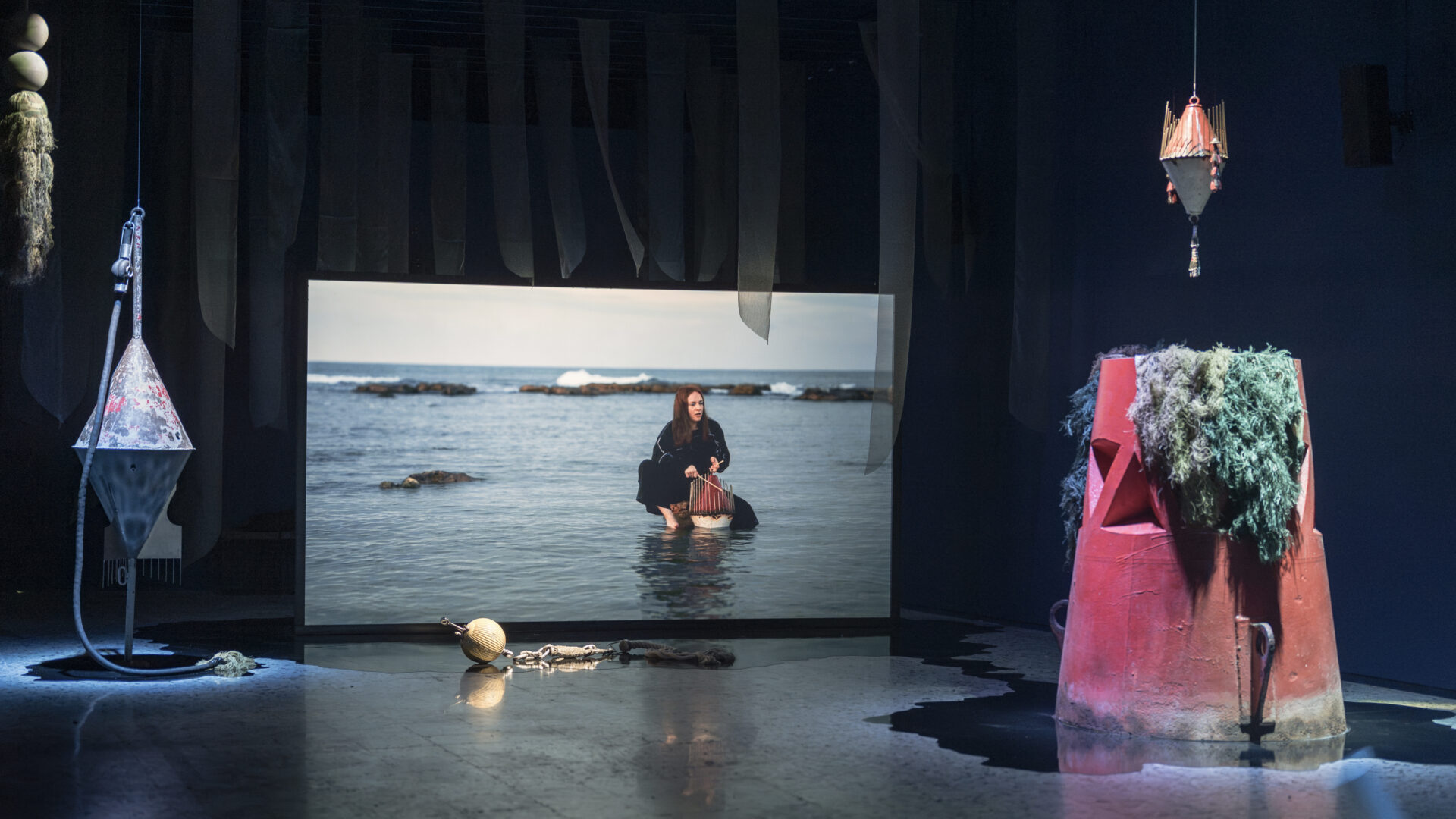
In the Romanian Pavilion, the artist duo Anca Benera and Arnold Estefán, curated by Corina Oprea and Diana Marincu, explore the Black Sea as a living archive.
Black Seas – Scores for the Sonic Eye tells the story of the Black Sea, its geographical location, geological composition and its role as a reservoir of layered human and Earth histories: In its depths, decomposition processes slow down considerably. The seabed thus becomes an archive of shipwrecks, sediments and microorganisms. Rather than erasing the past, the Black Sea preserves it like a time capsule deposited in layers.
The artistic work by Benera and Estefán combines sound, moving image and sculpture to form a multi-layered narrative about ecological, historical and political processes. Migration, resource extraction, conflicts and environmental changes emerge here as intertwined stories that continue to shape the region to this day.
Slovenia: A Forgotten Mosque and the Politics of Memory
In the Slovenian Pavilion, curator Nataša Petrešin-Bachelez presents the work Soundtrack for an Invisible House by the Nonument Group. The starting point is the story of a mosque, now largely forgotten, which was built by the Austro-Hungarian army during the First World War.
By combining sound, space and historical research, the project explores the relationships between religion, power and collective memory. Visitors are invited to reflect on stories that have faded from public consciousness, as well as on the mechanisms through which societies remember, forget or construct certain narratives. This creates a space for engaging with issues of belonging, cultural heritage and social inclusion. In the video, Nataša Petrešin-Bachelez talks about art as a practice of remembrance and how hidden stories and social connections can be made visible. Drawing on the history of the mosque, she reflects on questions of belonging, coexistence and the visibility of minorities.
New perspectives on shared challenges
The three works from Moldova, Romania and Slovenia follow different artistic strategies but share a common approach: they focus on hidden stories, fragile memories, ecological interdependencies and the impact of political conflicts on people’s everyday lives – issues that extend far beyond the Biennale.
Particularly in times of social polarisation and growing uncertainty, art and culture create spaces for exchange, critical reflection and new perspectives. By supporting artists, curators and cultural networks in Central, Eastern and South-Eastern Europe, ERSTE Foundation helps to strengthen such spaces and highlight connections across national borders. The projects presented here exemplify how art brings complex contemporary realities to life, fosters dialogue between different experiences and opens up new visions of how we can shape our shared way of living together.
The 61st International Art Exhibition of the Venice Biennale, In Minor Keys, runs from 9 May to 22 November 2026 at the Giardini, the Arsenale and other venues in Venice.
Header image: Anca Benera & Arnold Estefán, Black Seas – Scores for the Sonic Eye, photo © Samuele Cherubini