Journal
2 April 2026
Reading Time: 14'
Reading Igor Zabel Today By Charles Esche
It is now twenty years since we tragically lost the art historian, curator, and versatile intellectual Igor Zabel. We can only imagine what his contribution would have been in an alternative universe, had he lived longer. His work, as evidenced both in exhibitions and the writings in this publication, opened a space for thinking about art and society that remains vital to understanding the cultural sphere today. Indeed, as the conflicts in Europe and the Middle East intensify, Zabel’s comprehension of what replaced the Cold War and its ideologies becomes even more significant. In his writings, the reader will find a quizzical, critical witness to the end of socialism, the painful break-up of Yugoslavia in the first nationalist European war since 1945, and the emergence of a single European order within a global settlement that nevertheless kept cultural and political divides firmly in place.
Zabel writes eloquently about his experiences as a person from central Europe who was frequently labelled as coming from »the former East.« He remained doubtful of an implied identity politics that would essentialize the »East«, but that reads today as a contemporary dilemma. At the same time, he understandably felt the need to confront the Western arrogance that made no effort to distinguish between the old socialist states nor understand the histories of internal European imperialism that had predated them. Importantly, however, this criticism was less directed at the ignorance of the West than at the need for new and multiple narratives that should be generated in the territories from the Adriatic to the Urals and beyond. This call was only rarely answered in the years after his death, but it continued in the work of the Museum of Modern Art+Museum of Contemporary Art Metelkova in Ljubljana under the directorship of his colleague Zdenka Badovinac. One can also observe its influence on a few institutions such as the Museum of Modern Art in Warsaw and the Erste Foundation in Vienna, both of which are more or less unthinkable in their current form without Zabel’s speculations. His legacy is therefore a very tangible one, though for a curator such as myself working in north-western Europe, it remains much too undervalued. This is particularly so when Zabel steps beyond the »Eastern« domains that were at least partly allowed to him by the hegemonic art world, to ask about the wider context in which the work of Slovene and other artists find themselves discussed and presented. Thus, when he asked the question »does anyone speak about the former West«,1 he was asking what effect the end of socialism has had on the old capitalist part of Europe and its North American patron. Such was the impact of this little phrase that it inspired a multi-year project created by Maria Hlavajova that stretched across the continent from Utrecht to Istanbul from 2009 to 2017.2
As the world moves even more clearly beyond the century of US hegemony in Western Europe that the term »former West« implied, the question of how the West deals with the demise of its supremacy haunts the culture and politics of the capitals that, in Zabel’s time, had genuinely hoped to record the end of history. Reading the texts here alerts us to a time when different choices might have and even were partly pursued, when the destination of Russia was still an open question, and when the capacity of Europe to offer a path betweenfree-market and socialist dogmas was not entirely extinguished. In that sense, it was undoubtedly a more optimistic time, although even then, there is always an ambivalent undertone in Zabel’s writings that asks the reader to pause a moment before being carried away on the wings of possibility. What does stand out, however, is his desire to propose and see realized another way of thinking about art that is unconstrained by its modernist inheritance while openly recognizing its influence. He is also always focused on the alternative narratives that art institutions can offer to a Slovene society in political transition that is uncritically swallowing the values of capitalism wholesale. Thus, when he confronts the ideas of an anonymous Eastern European art critic who has had enough of the »East«, he reaches to Russian theorists and curators Boris Groys and Josef Backstein for support in explaining what that term might have to offer. He ends by speculating about how a broader, less exclusionary art historical narrative that included socialist realism alongside autonomous modernism could change the idea of art in the »West« just as much as in the »East« 3 Here it is also worth noting how much this dialogue between Slovenia and Russia influenced his work – a dialogue which bore much promise but is now completely impossible.
In what is possibly one of his more prescient texts, Zabel strays beyond the European divide to speculate about how a new understanding of the legacies of colonialism and imperialism might create conditions for a renewed relation between (Eastern) Europe and the rest of the world. Taking Rasheed Araeen and Slavoj Žižek as his interlocutors, he constructs an argument that has even more resonance today, and that is worth quoting here again at length:
The struggle against hegemony in terms of race, ethnicity, gender, etc., indicates a fight between an older, patriarchal, and colonial system in which these differences were functional, and a more recent one in which the differences are not useful anymore and can even be an obstacle. We can also assume that this shift corresponds with the shift toward global, multi-national capitalism … But even the global structures of power are not completely deterritorialized, completely »virtual« … one effect of globalization is the centralization … [I]n major cities … [g]lobal power is thus not only connected to the West, but … the West has redefined its crucial role inside the global power system … This vision of impersonal global capital colonizing the whole world and collecting symbolic values in its »command points« sounds very pessimistic.4
It would be easy to add, »but very reasonable and realistic« after »pessimistic«, at least based on the experience of the past twenty years. In essence, this whole extract condenses a history that had barely begun when Zabel wrote it in 1998. The claimed end of colonial relations of power has been simply reproduced by capital. Today, as societies across the former East and West reap the harvest of centralization and neo – colonialism in culture wars and unbridgeable social divides, these words carry a new urgency to help understand how it was that the world shifted from the possibilities at the end of real existing socialism to the impossibility of oligarchic autocracies today.
While this makes Zabel out to be something of a prophet, it is important to understand that much of his understanding of his contemporary situation was drawn from artists (Slovene and international) whose work was precisely sensitive to the kinds of changes he is so acutely observing here. The production of artists such as Ilya Kabakov, IRWIN, Laibach, Marjetica Potrč, and Rasheed Araeen form the basis of his thinking. In some of his texts, the reader can almost reconstruct his exchanges with artists, and the subjects in his texts are often the direct results of networks that passed straight through Ljubljana, such as the relationships with Russian artists and critics cultivated particularly by IRWIN in the 1990s, or the presence of Josef Dabernig, one of the very few Austrian artists interested in the territories to Vienna’s east. In a wonderfully concise yet comprehensive text about Mladen Stilinović, Zabel highlights the artist’s understanding of the everyday signs and gestures of socialist society in the 1970s and 1980s as a way to read across from them to the alienated social relations and empty promises of capitalism’s broken system in his own time, and even more so today.5 Writing about IRWIN, he takes their iconic series Was ist Kunst as a vehicle to reveal how context and the relation with power are defining aspects of the work, and that no »figure, image, or sign conveys meaning in, and of, itself«.6
These shorter, monographic texts are a very important addition to this collection, because they show how works of art significantly shaped the writer’s thinking about broader, sociopolitical topics.
If a quizzical ambivalence defines Zabel’s relationship to the projected division between Eastern and Western European art that he inherited with his generation, it is as much because of his own thoughtful questioning of binary categories in general as it is a way to undermine the conservative Western position. This is why he never comes over as angry about or upset by the attitudes of the critics who visited him from the former West. Overcoming, or at least mitigating, the simplicities of definitions and opposites were a fundamental part of his way of thinking, as can be read in his address to questions of autonomy and commitment or independence and context that extend across his writings. One text in this volume titled Commitment (2002) is especially relevant here. It grounds the question of art’s autonomy vs commitment in the context of the Bosnian war and genocide of the mid-1990s. Considering his community’s need to address the horrors happening a few hundred kilometres south of Ljubljana, he points out the powerlessness of art to make a difference. A group, including IRWIN and Zdenka Badovinac, together decided to ask artists across the world to donate works to a collection for Sarajevo. In this way, the question of artistic commitment was expressed not through works themselves, but through the gesture of solidarity and generosity toward a different, future Bosnia and Herzegovina, where those works could be displayed for a public. On this basis, Zabel argues that autonomy and commitment are not opposites, nor does the tension between them need to be resolved. Instead, the one can give force to the other – autonomy allowing for effective political art, just as political art relies on a distance from direct action in order to have an artistic existence. In an intriguing final paragraph, he praises the Greenbergian quality of opacity in art as a way to resist appropriation by power. He then opposes transparency to opacity and concludes by saying that, »Today, I think, this opposition has largely shifted into the temporal dimension of the work: it is the particular experience of the ‘not-yet-colonized’ time that acts as the ‘real’ – the point of resistance that the system is unable to absorb and appropriate«.7
Twenty years later, facing another genocide in Palestine and searching even within Western Europe for a way out of colonial time and its violence, this last remark bears further analysis. Is this »not-yet-colonized« time a condition where or when some Eastern European practices could build coalitions with indigenous and Global South positions? Is there a way to use time to get a distance from an all-pervasive colonial system and to create relations that are not predetermined by power? Like »former West«, this passing mention touches on questions of power, and who is able to define the terms of the debate. It contains within it a theme that runs through all of Zabel’s writings, in which he insists on thinking about and analyzing how art negotiates with power, whether it is the violence of conflict or the arrogance of Western critical ignorance. However, in his turn toward time he adds the suggestion that there might be a non-spatial escape from power’s reductive influence through rethinking time itself.
Zabel is undoubtedly a product of his own time, however, and reading his texts it does feel that there was more room to maneuver in a more plural art world than the destructive polarization we find ourselves in today. The financialization of art, its reduction to a luxury product, and the more recent marketization of first outsider art and then indigenous artistic practices has partly closed off some of the routes that Zabel would undoubtedly have pursued differently had he lived. Yet his relevance is largely because many of his proposals and intuitions have yet to be explored by the art establishment in any consistent form. Especially within Europe (taken as a whole), the urgency to recognize the profound changes that happened around 1989 with the end of communism and how it continues to shape artistic and political discourse today is profound. The ongoing refusal to address the forms of art from the socialist part of Europe, or see socialist internationalism as a viable alternative to globalization is distressing. These failures are made all the more critical by the financial crisis around 2008, which transformed entrepreneur-led free-market capitalism into an even more dysfunctional rentier and asset management financial system. These major political and economic events have changed art profoundly, yet Zabel anticipated much of what has happened in his writings, though the violence and impunity of the oligarchic class today might have shocked him still. While the extreme polarization in Europe and beyond is undoubtedly a sign that we live in a different, harsher era in 2026, these writings make it possible to understand some of the crucial causes of the present impasse. This is one of the essential reasons why Zabel’s writings remain so relevant today, even after more than two decades and all that has changed in between.
It is therefore probably true that the writings in this book are more relevant because of this collective failure of the European (art) system to acknowledge sufficiently how deeply conditions have changed over thirty-five years. Especially in the West, there remained for a long time a deep desire in both the art media and the public sector to cleave to the modernist shibboleths of artistic autonomy and universal visuality. This conservatism has only shifted a little, and in the meantime the collector/oligarch class has had free rein to build their own contemporary art treasure houses. As a result, public art institutions have been forced onto the defensive, still unwilling or unable to abandon modern models of display and narration for fear of what would replace them. The real exceptions to such conservative inertia – the museums and art spaces that do not just insist on expanding their Western story across the world, but are also shaping a new narrative – are few, but very significant. It is in these places that Zabel’s legacy lives most vividly. His core questions of how to retain knowledge that will help understand and respond to a new context; how to adapt the local to the demands of artistic globalization and identity politics while refusing Western tutelage; and how to address the past independently, without allowing hegemonic power to determine it all, remain just as sharp and poignant as they were when first composed. In the end, the texts collected here offer a perceptive guide to understanding the causes of the grim present, as well as crucial intuitions about how it could still be different.
Summer 2025
1 Igor Zabel, »Dialogue«, first published in Art Press, no. 226, Paris, July–August 1997, p. 37–42.
2 See the project’s website https://formerwest.org/Front and its publication at https://formerwest.org/Publication (last accessed November 2025).
3 Igor Zabel, »Haven’t We Had Enough«.
4 Igor Zabel, »‘We’ and the ‘Others’«, first published in Moscow Art Magazine, no. 22, Moscow, 1998, p. 27–35.
5 Igor Zabel, »A Short Walk Through Mladen’s Stilnović’s Four Rooms«, in Mladen Stilinović. Umetnik na delu: 1973–1983, Galerija Škuc, Ljubljana, 2005, p. 8–25.
6 Igor Zabel, »Icons by Irwin«, in IRWIN. Retroprincip 1983–2003, Künstlerhaus Bethanien, Berlin; Karl Ernst Osthaus-Museum, Hagen; Museum of Contemporary Art, Belgrade; Revolver – Archive für Aktuelle Kunst, Frankfurt am Main, 2003, p. 77–83.
7 Igor Zabel, »Commitment«, in Prostori umetnosti, Druitvo inovatorjev, Ljubljana, 2002, p. 161–169.
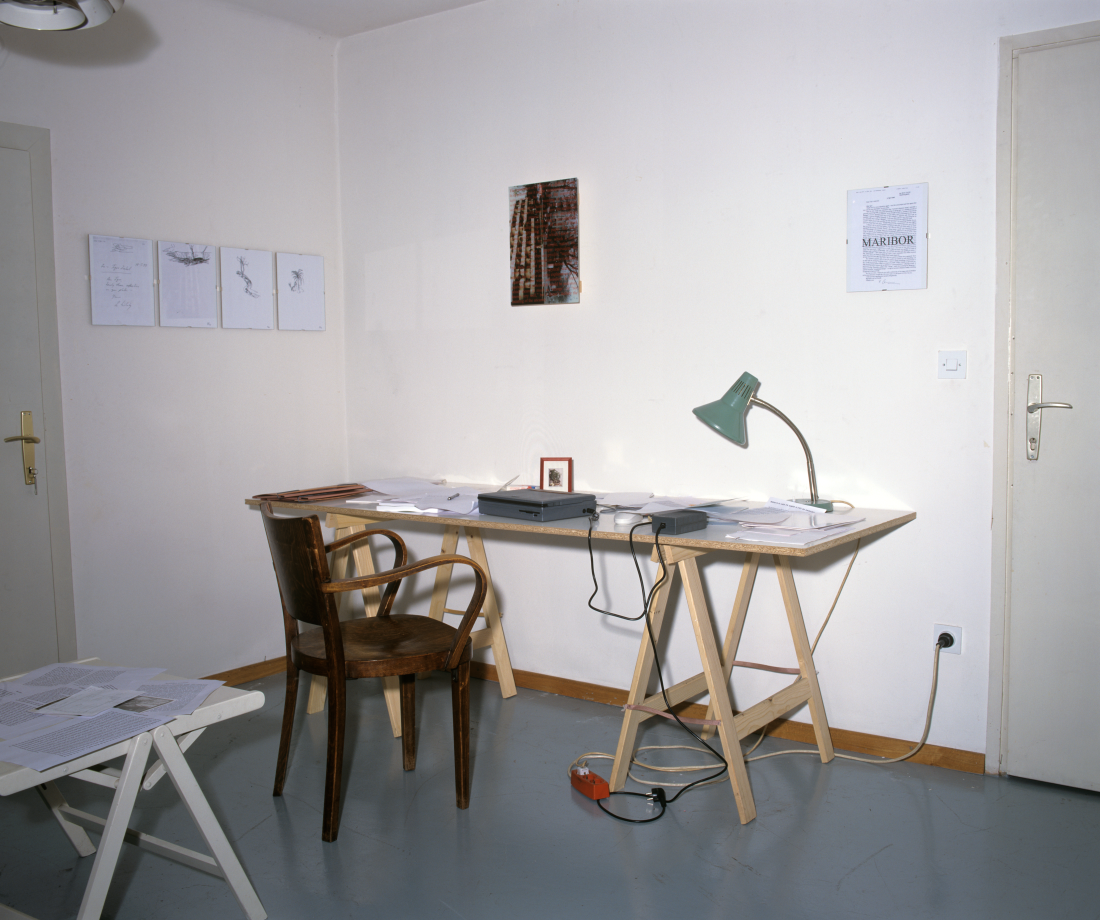
Igor Zabel’s temporary office and the space for Igor Zabel’s exhibition »Nerazložljiva navzočnost (Kustosova delovna soba) / Inexplicable Presence (Curator’s Working Place)«, Moderna galerija, Ljubljana, 20.5.1997 – 31.5.1997. Photo: Lado Mlekuž, Matija Pavlovec /Courtesy of Moderna galerija, Ljubljana